Creating a good coding challenge is deceptively hard. If you've ever had to create a code challenge, you know the pain: crafting a clear problem statement, writing sample tests that guide without giving away the answer, building hidden tests that catch the shortcuts, and wiring up a reference solution that all hangs together. It easily takes hours.
We built DojoCode's MCP integration to compress that process from hours to minutes — while keeping experienced humans in the loop where it matters most.
This post walks through how it works, what the research says about AI-generated challenges and tests, and what developers actually thought when they tried it.
What the MCP integration does
The Model Context Protocol (MCP) is an open standard for connecting AI-powered tools to external services. Rather than a one-off plugin, it's a protocol-level capability supported across multiple environments — Claude Code, Cursor, VS Code with Copilot, Gemini CLI, and any other MCP-compatible client.
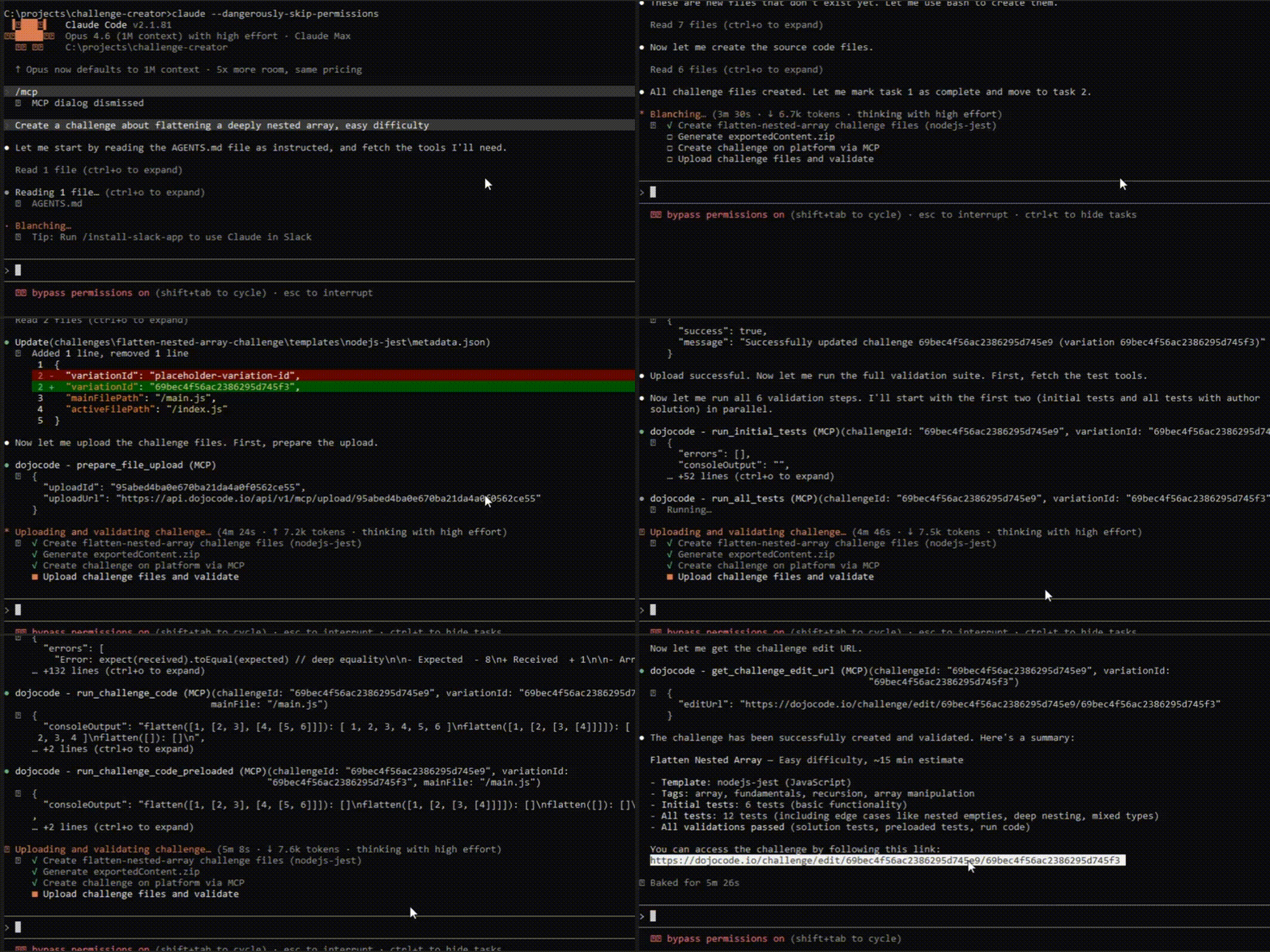
DojoCode exposes an MCP server that lets you go from a natural-language idea to a complete, runnable challenge package without leaving your IDE:
Describe what you want
Tell your AI assistant what kind of challenge you need — topic, difficulty, language.
MCP generates the bundle
Problem statement, starter code, sample tests, hidden submission tests, and a reference solution — produced via structured tool calls.
Automatic validation
The MCP runs initial tests and full submission tests against both the reference solution and the preloaded starter files — automatically, as part of the generation workflow. No manual test execution needed.
Review, adjust, publish
Refine what needs refining and publish to DojoCode's sandboxed environment.
What "production-ready" actually requires
A coding challenge isn't a single file — it's a description, starter code, sample tests, hidden tests, and a reference solution that all need to be consistent with each other. For trainers evaluating whether AI-generated output is good enough for real use, these are the quality gates that matter:
Test suite shape
Industry practice recommends 2–3 sample test cases that clarify expected I/O, plus 8–15 total cases covering distinct scenarios — empty inputs, boundary values, performance constraints, off-by-one errors. Redundant tests that check the same behavior add noise without value.
The gap between "passes" and "good"
A 2025 study analyzing AI-generated code found no direct correlation between passing unit tests and overall code quality or security. Green tests are necessary, but not sufficient — which is exactly why human review isn't optional in this workflow.
Coverage ≠ effectiveness
Once you control for suite size, the correlation between code coverage and test effectiveness is low to moderate. Coverage spots untested areas, but treating it as a quality target creates false confidence. What matters is whether the tests catch incorrect solutions — a judgment call, not a metric.
What we're hearing from developers
We asked developers to take the MCP integration for a spin: generate a challenge from scratch, evaluate the output, and tell us honestly what worked and what didn't. Feedback was structured around clear evaluation criteria — problem clarity, test quality, realism for evaluation, and time savings.
Full feedback →
On senior-level challenges: "Yes, but probably you need to intervene and double check because the AI might not be fully capable to do it alone."
Risks: "The challenge can be solved by another AI the users can use."
Use case: Generating custom challenges for recruiting.
What to improve: "The readme could be clearer and show an example of how to prompt the AI."
Full feedback →
First impression: "I was impressed by how quickly it went from idea to a fully functional challenge. I just said 'come up with a Vue 3 beginner challenge' and it proposed several options."
What surprised him: The tool translated a single challenge into all 8 frontend frameworks (Vue, VueTS, React, ReactTS, Svelte, VanillaJS, VanillaTS, Angular) in one go — with framework-appropriate syntax, correct test imports, and proper project structure. It also self-corrected when tests failed.
On senior-level challenges: "Yes, with the right prompting. If you specify advanced patterns like state machines, concurrency handling, or system design components, it can generate appropriately complex challenges."
Risks: "Generating challenges too similar to common LeetCode-style problems, which candidates could solve by recognition rather than skill. Also subtle bugs in edge case tests that could frustrate candidates."
Full feedback →
Background: 50+ interviews for a software company, using challenges found on LeetCode or created manually.
What surprised him: The ease of use.
On problem statements: "9/10 — maybe some of the wording might not be that beginner friendly."
Manual adjustments: Not yet, but noted a few fixes to the proposed solution would have been needed.
On senior-level challenges: "Absolutely. LLMs are able to create senior-level challenges easily."
Risks: "No risk, however proper code review is required 100%."
Use case: Creating challenges for future interviews.
Being honest about the boundaries
If you're a trainer or mentor considering this for your workflow, here's the straightforward breakdown:
Automation handles well
- Rapid drafting of problem statements and test scaffolding
- Quick iteration on difficulty variants
- Starter code and solutions across multiple languages
- First-pass test suites covering common scenarios
- Automatic validation of tests against the solution and starter code
- Multi-framework translation of a single challenge
Human judgment still essential
- Verifying the problem tests what you intend
- Validating edge cases
- Validating that the problem description is thorough and clear
- Validating that test descriptions are thorough and clean
- Calibrating difficulty to your audience
- Ensuring assessment fairness and consistency
This pattern isn't unique to DojoCode. Research on large-scale LLM-based test generation — including Meta's deployment of mutation-guided test generation across thousands of classes — consistently shows the same result: AI-assisted generation delivers real value when paired with human review and selection.
Ready to try it out?
Clone the starter repository, open it in your MCP-compatible IDE, and authenticate with your DojoCode account. The full setup guide covers each environment:
Challenge authoring tools are available to Premium subscribers, Business accounts, and community members who've earned 300+ XP points on the platform.